AI Transformation
How to Identify AI Opportunities in Your Business
A practical guide to finding where AI, automation and connected systems can create real business value.
Stephen Power · · 16 min read
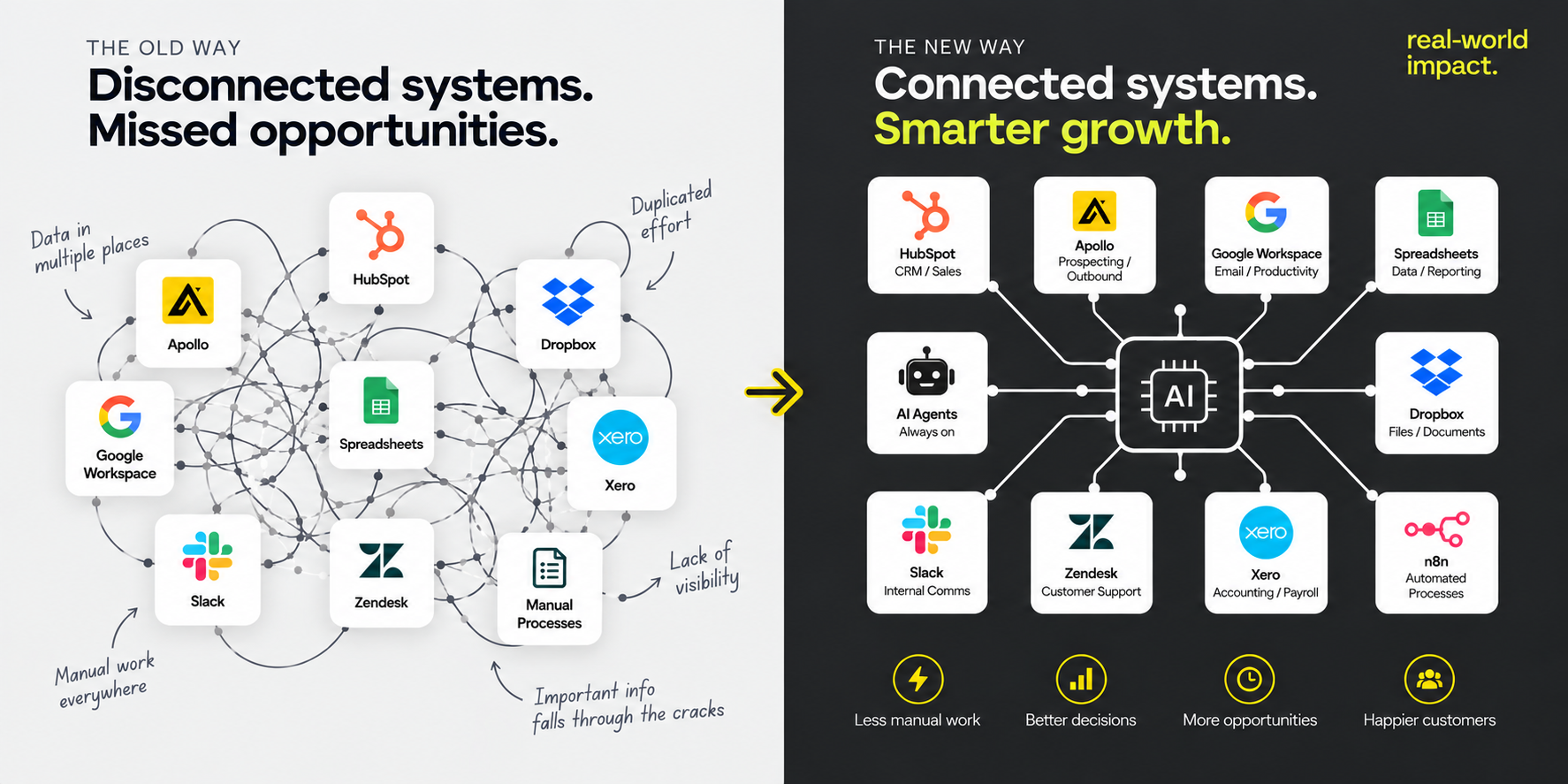
Most businesses don't need another AI tool. They need a clearer understanding of where their time, money and commercial opportunities are being lost.
Consider a sales team that spends hours researching prospects, updating CRM records, preparing proposals and chasing colleagues for information. Or an operations team that manually transfers the same information between three different systems.
The immediate temptation might be to introduce an AI agent or automate individual tasks.
But what if the real problem is that the systems aren't connected? What if the process itself is unnecessarily complicated? Or what if the greatest opportunity isn't saving time at all, but enabling the business to generate more revenue?
The starting point for AI transformation isn't the technology. It's understanding how the business actually works, what it's trying to achieve and what's preventing it from getting there.
Here are the questions we'd start with.
1. How much time is spent on work that doesn't create direct value?
Start by looking at how people actually spend their working day.
For a sales team, that means understanding how much time is spent speaking with prospects and customers versus researching, entering data, preparing documents and completing administrative tasks.
For operations, it might mean examining how much time is spent coordinating work, updating spreadsheets or manually processing information.
Ask yourself:
- How much time do your salespeople spend on actual sales calls and customer meetings versus administration?
- How many hours per month are spent preparing reports, proposals, quotes or other documents?
- Which tasks involve repeatedly copying, formatting, checking or transferring information?
- How often do employees have to search for information that should already be available?
- Which activities are repeated frequently but require relatively little human judgement?
The important distinction is between work that genuinely requires someone's expertise and work that simply consumes their time.
A salesperson's value is often in understanding customers, building relationships and closing opportunities. Manually transferring information between systems may be necessary today, but it isn't necessarily the best use of their time.
The opportunity: Reduce unnecessary administrative work and give people more capacity for activities that create business value.
That might involve connecting existing systems, redesigning workflows, introducing automation or using AI to handle specific tasks.
It doesn't automatically mean replacing the people doing the work.
2. How many systems does it take to complete one process?
Many businesses have invested heavily in software without necessarily creating an efficient operating environment.
Sales has its CRM. Finance has its accounting software. Operations has its project management platform. Customer information sits in shared drives, email conversations and spreadsheets.
Individually, these tools might work perfectly well.
The problem often appears when information needs to move between them.
Consider what happens when a customer requests a quote.
Does the salesperson need to check a spreadsheet for pricing, contact operations for availability, obtain approval from finance and manually assemble a proposal?
If so, the opportunity might not be an AI quotation tool.
It might be connecting the information and redesigning how the entire quotation process works.
Ask yourself:
- How many different systems are involved in completing a typical customer request?
- Does information need to be manually transferred between those systems?
- Is the same customer, product or transaction information stored in multiple places?
- Do employees have to switch between several applications to complete one task?
- Where do people rely on email or spreadsheets to compensate for disconnected software?
- Can employees access the information they need without asking another department?
The opportunity: Create connected workflows where information moves between systems without unnecessary manual intervention.
Once that foundation exists, AI can potentially add another layer of value through analysis, recommendations, intelligent document processing or automated decision support.
But connecting the data may be the most important first step.
3. Where is work being duplicated across departments?
One of the most overlooked sources of inefficiency is cross-functional double handling.
A sales representative enters customer information into the CRM. Operations then copies it into a project tracker. Finance enters the same information into an invoicing system.
Meanwhile, somebody maintains a separate spreadsheet because the information in the other systems isn't complete or reliable.
Three departments may be doing variations of the same work, with each additional handoff creating opportunities for errors and delays.
This is particularly common in businesses that have grown quickly, adopted new software over time or developed processes independently across departments.
Ask yourself:
- How many times is the same information entered during a customer or project lifecycle?
- Does one department recreate reports or documents that another department has already produced?
- Are different teams maintaining separate versions of the same customer or project data?
- Which activities require employees to copy information from emails into another system?
- How often does work have to be repeated because information was missing, incorrect or outdated?
- Where does one department's output become another department's manual input?
A useful exercise is to follow one transaction from beginning to end.
For example:
Customer enquiry → Sales → Operations → Finance → Delivery
At every handoff, ask what information is transferred, who transfers it and whether that activity genuinely needs to happen manually.
You may discover that the greatest opportunity isn't within any individual department.
It's in the gaps between them.
The opportunity: Eliminate duplicate data entry, connect departmental workflows and establish more reliable information across the business.
4. Which spreadsheets are holding your business together?
Spreadsheets are incredibly useful. The problem isn't that businesses use them.
It's when spreadsheets become the unofficial operating system for processes that have outgrown them.
You might have a spreadsheet containing product prices, another tracking customer orders, another calculating margins and several more being maintained independently by different employees.
Eventually, critical business processes depend on people remembering which file to update, which version is correct and how the information should be transferred elsewhere.
Ask yourself:
- Which business-critical processes depend on spreadsheets?
- How many people maintain or update the same spreadsheet?
- Does information have to be copied from a spreadsheet into another system?
- Are important calculations, pricing rules or approval processes managed manually?
- How often do employees need to reconcile different versions of the same information?
- What happens when the person who maintains a particular spreadsheet is unavailable?
- Which spreadsheets exist because your current software cannot support the process?
Not every spreadsheet needs replacing.
Some are perfectly appropriate for occasional analysis or simple record-keeping.
But when a spreadsheet becomes a central part of a recurring operational process, it may indicate an opportunity to build something more reliable.
The opportunity: Turn fragmented spreadsheet-based processes into connected workflows, structured data, automated calculations or purpose-built applications.
For example, a business managing complex quotations across multiple pricing spreadsheets could potentially benefit from a connected quotation system that brings together product information, configuration rules, pricing and margin controls.
The value isn't simply eliminating spreadsheets. It's improving the speed, consistency and commercial performance of the underlying process.
5. Where does work stop and wait for someone?
A task might require only 20 minutes of actual work but take three days to complete.
Why?
Perhaps the employee needs information from another department. A manager must approve a decision. Finance needs to verify pricing. Or somebody must manually review a document before the process can continue.
These delays can be more commercially significant than the time spent completing the task itself.
Ask yourself:
- Which processes regularly stop while waiting for another person or department?
- How many managerial approvals are required to complete a typical transaction?
- Which decisions follow established rules but still require manual review?
- How long does a process take from beginning to end versus the time spent actively working on it?
- Where do customers experience delays because of internal handoffs?
- Which approvals could be simplified using clearer rules, better information or automated checks?
Consider a quotation that takes 30 minutes to prepare but two days to approve.
Automating the document creation might save 20 minutes.
Redesigning the approval process could potentially reduce the overall turnaround time by much more.
That doesn't mean removing human oversight from important decisions.
It means identifying where human judgement is necessary and where routine checks or established business rules can be handled more efficiently.
The opportunity: Reduce unnecessary waiting time, simplify approvals and introduce automated checks or decision support where appropriate.
6. Where is commercial value being left on the table?
So far, we've focused heavily on operational friction.
But AI transformation shouldn't be limited to making existing processes faster or cheaper.
Some of the most interesting opportunities involve improving how a business generates revenue, serves customers, protects margins or develops new capabilities.
For a sales organisation, the issue might not be how much time employees spend on administration.
It might be that they're spending their limited selling time on the wrong opportunities.
For a service business, the problem might be that customer enquiries are not followed up quickly enough.
For a manufacturer or equipment supplier, it could be that complex pricing and configuration processes prevent the sales team from presenting commercially viable alternatives.
Ask yourself:
- How many incoming leads or customer enquiries receive no meaningful follow-up?
- How quickly does your business respond to new commercial opportunities?
- Are salespeople spending their time on the opportunities most likely to create value?
- Where do slow processes affect customer conversion or retention?
- Are pricing decisions consistent, and do employees have the information needed to protect margins?
- What customer information exists that could help identify new opportunities?
- Are there products or services you could offer if the cost of delivering them were significantly lower?
- What decisions could improve if employees had access to better, more timely information?
The opportunity: Use connected data, better processes and AI-enabled capabilities to improve commercial performance rather than simply reduce operating costs.
For example, an intelligent prospecting workflow could identify and prioritise potential customers based on their fit and relevant buying signals.
Instead of spending hours manually researching hundreds of companies, a salesperson could focus on a smaller group of qualified opportunities with useful context already available.
The objective isn't just faster research.
It's creating more capacity for meaningful sales conversations and improving the quality of the opportunities entering the pipeline.
7. What would the ideal process actually look like?
Once you've identified where time, money or commercial opportunities are being lost, resist the temptation to immediately choose a technology.
First, describe what the process should look like if you were designing it today.
Take a typical sales workflow.
Current state
A new enquiry arrives. A salesperson manually researches the company, checks several systems, updates the CRM, contacts a colleague for additional information and prepares a response.
The process involves multiple handoffs, duplicated information and administrative work before the salesperson has a meaningful conversation with the customer.
Future state
A new enquiry arrives. Relevant customer information is automatically collected and connected to the CRM. The opportunity is assessed against defined commercial criteria, and the salesperson receives the information needed to respond.
The salesperson can focus on understanding the customer's requirements and progressing the opportunity.
Now the technology question becomes much clearer.
Which systems need connecting? Which steps can be automated using existing software? Where would AI genuinely improve the process? Which decisions should remain with a human?
The opportunity: Design the future operating model first, then select the combination of technology, automation and human involvement required to deliver it.
This is the difference between automating an inefficient process and actually transforming how the business operates.
How to quantify the opportunity
Identifying an inefficient process is useful. Understanding its commercial impact is what allows you to decide whether it's worth changing.
You don't need accounting-quality precision during an initial assessment. Reasonable estimates can help establish whether an opportunity deserves further investigation.
Start with five questions.
| Question | What to establish |
|---|---|
| How often does it happen? | Number of transactions or occurrences per month |
| How much time does it require? | Total human effort per occurrence |
| Who is involved? | Number of employees and approximate loaded hourly cost |
| What happens when it goes wrong? | Rework, errors, delays, lost sales or margin leakage |
| What could improve? | Time, cost, revenue, conversion, customer experience or decision quality |
An illustrative example: Manual sales administration
Imagine a business with 10 sales representatives, each spending 10 hours per week on repetitive administrative activities.
At an illustrative loaded employment cost of $40 per hour:
| Measure | Illustrative value |
|---|---|
| Sales representatives | 10 |
| Administrative hours per rep per week | 10 |
| Total administrative hours per week | 100 |
| Total administrative hours per year (52 weeks) | 5,200 |
| Annual employment cost associated with that time | $208,000 |
That doesn't mean the business can automatically save $208,000 by introducing AI.
Some administrative work will remain necessary. Some activities may be difficult to automate, and new systems introduce implementation and operating costs.
More importantly, the business may not want to reduce headcount at all.
If the team could recover even part of that time, the commercial opportunity might be to redirect it towards customer conversations, prospecting, relationship development or progressing existing opportunities.
The next question becomes:
What would the business gain if its salespeople could spend more time actually selling?
That is a different business case from simply calculating the cost of the hours they currently spend on administration.
The same principle applies to operations, finance, customer service and other functions.
Where a process affects revenue, margins or customer experience, those consequences should be assessed alongside the time and cost involved.
How to decide which opportunities are worth pursuing
By this stage, you may have identified several potential opportunities across the business.
Not all of them will be worth pursuing.
A process that consumes hundreds of hours might be difficult to change because it depends on inaccessible systems, poor-quality data or complex regulatory requirements.
Another process might take relatively little time but have a significant effect on sales conversion or customer retention.
Before committing to a solution, consider:
- Business impact: What measurable commercial or operational improvement could this create?
- Feasibility: Is the necessary data available? Can the relevant systems be connected? Are there technical, security or operational constraints?
- Implementation effort: What would it take to design, build, test and maintain the solution?
- Time to value: How quickly could the business validate whether the proposed change works?
- Risk: What happens if the system makes a mistake, produces an incorrect recommendation or fails?
A useful starting point is to prioritise opportunities with meaningful business impact, manageable implementation complexity and a clear way to measure success.
Sometimes the right first project is a small, tightly scoped workflow that can be tested quickly.
Sometimes it's connecting the data and systems needed to enable several future improvements.
And sometimes the conclusion is that the business needs to change an existing process before introducing any new technology.
The objective is to identify the right intervention, not justify an AI implementation.
From opportunity to implementation: The Domani approach
At Domani Works, we approach AI transformation through four stages.
01 DISCOVER
Understand the business objective, examine how the current environment operates and identify where value is being lost, constrained or left on the table.
Assess the opportunities and establish which are worth pursuing.
02 DEFINE
Map what the future state should look like.
Determine which processes need redesigning, which systems and data need connecting and where AI, automation or custom software could create meaningful value.
Establish the scope, business case and success measures before committing to a build.
03 BUILD
Turn the proposed solution into a working capability.
Connect the relevant systems, develop the workflows, AI agents or custom applications, and test the solution against real business requirements.
Validate that it works before expanding its use.
04 SCALE
Deploy the solution, support adoption and measure its performance against the original business objectives.
Refine what works and identify where the capability can create additional value across the business.
Technology is an outcome of the process, not the starting point.
Where should your business start?
You don't need a fully developed AI strategy or a detailed technical specification to begin.
Start with one business objective and one process that is preventing you from achieving it.
Look at how work moves between people, departments, spreadsheets and software. Identify where time is consumed, where information is duplicated, where decisions are delayed and where commercial opportunities are being missed.
Then ask what a better version of that process could look like.
The answers may point towards AI, automation, connected data, custom software or a simpler operational change.
The important thing is that the solution follows the business opportunity, not the other way around.
Not sure where to start?
At Domani Works, we help businesses identify commercial and operational opportunities where AI and technology can create measurable value, then design and build the solutions.
If you have a process that's slowing your business down, disconnected systems that need bringing together or an opportunity you think technology could help unlock, we'd be happy to explore it with you.